“Those B-47s exploding over America could hardly be denied for long.”
IT WAS JUST supposed to be a routine training flight, not one of our highly classified Arctic missions refueling warplanes flying reconnaissance or provocation operations into Soviet airspace.
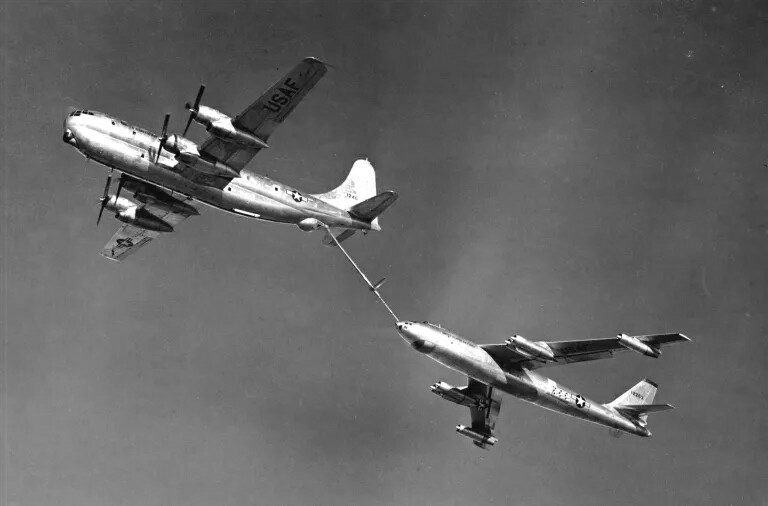
The date was April 10, 1958. Our KC-97G tanker was orbiting over Lake Erie. We were waiting for a B-47 Stratojet out of Lockbourne AFB, Ohio. When we heard from the bomber, we got a VFR clearance to refuel on a track 12 miles south of the Buffalo-Rochester-Syracuse air way. The first signal from the B-47 reached us as a green squiggle on my transponder scope. I established radio contact and began talking him into rendezvous. We broke out of orbit and down the refueling track, and I told the bomber to begin its descent.
At one mile and closing fast, the B-47 was just slightly off dead center on my scope. I gave him a final correction. Their pilot came back: “Roger, I am now in visual con—”
Just as his transmission broke off, the green squiggle on my scope disappeared.
“Queen 76,” I called. “This is Tomcat 89. Do you read me?” No answer.
Chuck, our Aircraft Commander, interphoned back to the boom operator.
“Rector, do you see him back there?”
No answer.
“Rector, what the hell is going on?”
After a moment of silence, a reply came.
“Y-yes s-s-sir. He just blew up. Right behind us,” Rector stammered. “I’m okay.”
Chuck put us into a steep bank. A big fireball and a smaller fireball were arcing forward following the flight path we had just left and slowly looping down toward the ground. We circled above the flames and anxiously scanned the sky for parachutes. There were none. The fireballs hit the ground a half-mile from a highway. Traffic was stopping. The two explosions bracketed a farmhouse and started several brush fires.
Within 15 minutes, a dozen private planes, a small commercial airliner, and two rescue helicopters Chuck had called from the nearest airbase were circling the area. We watched as the firetrucks tried to get past the long line of stalled traffic. I checked my watch again: it was 5:30 p.m.
Investigators pinpointed the cause of the disaster. They did so even though many small pieces of the B-47 were gathered by souvenir hunters and hundreds of eyewitnesses gave contradictory reports. A number of people had observed a midair collision between two planes. Some saw one plane, trailing flames and dense clouds of black smoke for miles, heading toward another. Two or three reported a plane flying upside down before it exploded. A few said they’d seen the plane flying straight down into the ground.
The real cause was diagnosed from spectrographic tests of the debris and the pattern of its distribution on the ground. The wings of big jets are not rigid but flexible. This B-47 had metal fatigue from too much movement in the center wing section where the wings join. It’s like bending a thin beer can back and forth until it rips. When the center wing section snapped, the fuel lines running through it ruptured. The plane exploded almost instantaneously.
We had already been hearing rumors that B-47s were falling out of the sky like shot clay pigeons. Then on April 15, five days after the one behind our plane blew up, two more B-47s exploded in mid-air, one out of Pease AFB, New Hampshire, and one over Tampa Bay, Florida. Ten days later another B-47 crashed at Goose Bay, Labrador.
During an April 19 meeting of the U.N. Security Council, the Soviet Union denounced the constant overflights of its territory by American B-47s and B-52s. On May 1, Soviet defense minister Rodion Malinovsky charged that Strategic Air Command (SAC) bombers carrying hydrogen bombs were continually hurtling towards, and often over, the Soviet border. He decried these flights as “provocative.” The following day, U.S. Secretary of State John Foster Dulles claimed these flights never crossed the Soviet border. American warplanes were merely conducting reconnaissance missions, he said. According to Dulles, such operations were vital to thwart surprise nuclear attacks on the United States from secret air and missile bases in the northern U.S.S.R.
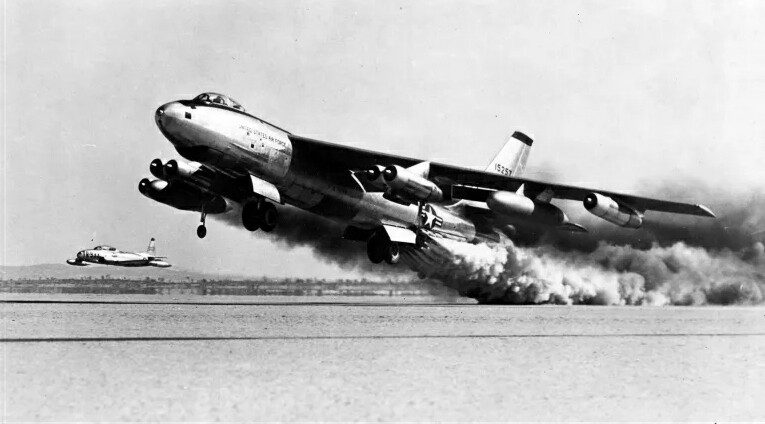
I decided to use my position in intelligence to do some private investigating. It turned out that at the end of 1957 SAC had decided that the B-47 was already obsolescent. With a ceiling of about 40,000 feet and a maximum speed of 600 miles per hour, it could not likely penetrate the increasingly sophisticated radar, antiaircraft missile and fighter defenses that ringed the Soviet Union. So the B-47s were ordered to practice LABS (Low-Altitude Bombing System maneuvers), better known as “toss-bombing.” The planes would approach enemy airspace at an extremely low altitude, using the landscape and curvature of the earth to block defensive radar. Once near their target, the planes would pull up sharply and simulate the release of a nuclear bomb, which presumably would continue in a long forward arc. The B-47, with its six jet engines slung under wings almost 120 feet from tip to tip, would have to climb into a backwards half loop followed by a half roll, as though it were a fighter plane. Enormous stress was placed on the center wing section, which of course was not designed for acrobatics. Within a few months of such training, B-47s were routinely disintegrating just like the one we had been about to refuel.
I also discovered that SAC had even been trying out its new technique on the Soviet air defense itself. Some of those B-47s we had been refueling in the far north would descend to below 1,000 feet and dash toward the Soviet Union. The planes would fly through Soviet radar, and then simulate their toss-bombing or another maneuver known as “pop-up bombing.” These were some of what Dulles described as purely defensive flights.
Who was telling the truth? There were no civilian eyewitnesses, much less media presence in the Arctic. But those B-47s exploding over America could hardly be denied for long. Back on March 13, two bombers exploded in midair, one directly over Tulsa, generating national publicity. Then came ours on April 10 and the two others that disintegrated in flight in the next five days. The Air Force response came on April 16, as recorded by The New York Times in this one-sentence article:
“The Air Force said today it was making a ‘thorough investigation’ of recent B-47 jet bomber accidents but did not consider the ratio of accidents to flying time ‘excessive or alarming.’”
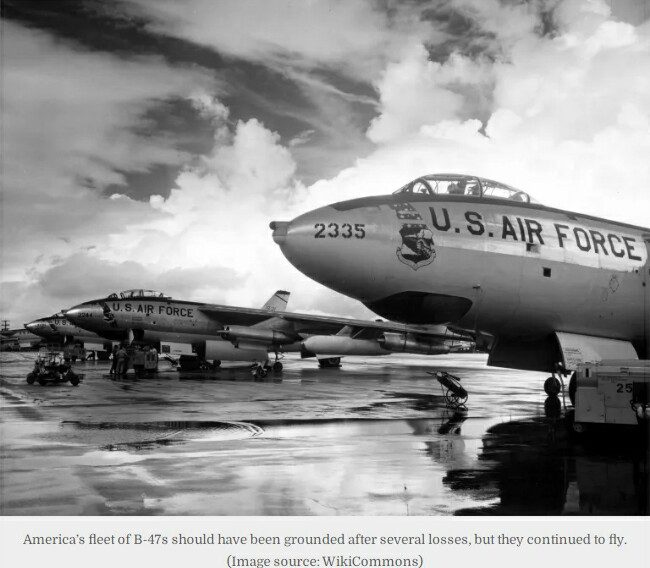
But on May 2, the Air Force acknowledged the loss of 14 B-47s along with 34 crewmen just since Jan. 1 (and this was an undercount of three bombers and 12 crewmen). The only loss specifically mentioned in the Air Force media briefing was the one behind us. Blaming the problem on “structural inadequacies,” it declared that the remaining fleet of B-47s would be “beefed up.” SAC combat units were informed that all B-47s were to be grounded until the center wing sections could be reinforced, in a secret operation code-named Project Milk Bottle.
The Air Force was still concealing the dimensions and implications of the B-47 story, which leaked out in dribs and drabs over subsequent decades. And even before the toss-bombing maneuvers, B-47s were disintegrating. In fact, planes were being lost as early as 1951. The first officially acknowledged midair explosion came in 1952. In 1955, just a few months after Jimmy Stewart in Strategic Air Command called the B-47 “the most beautiful thing I’ve ever seen in my life,” two exploded in midair, one over Texas and another over Kansas. In 1957, 27 B-47s blew up or crashed. Fourteen were lost in 1958 before our event on April 10. All losses that year eventually totaled 31. Many dozens of crewmen died in those 58 disasters in just these two years.
What about the Air Force claim that the ratio of B-47 accidents to flying time was not “excessive or alarming”? SAC at that time had 1,400 B-47s, almost exactly the same number of planes operated today by United Airlines and Delta combined. To put the B-47 catastrophe into perspective, imagine 58 United and Delta airliners blowing up in midair or being totally destroyed in fatal crashes in a two-year period. Here’s another comparison: In the three years of the Korean War, B-29s flew 27,000 sorties, often under heavy fire from radar-guided antiaircraft batteries and fierce attacks by formations of MiG-15 jet fighters; their total combat losses were 34 planes.
In 1980, the Air Force approved the public release of The History of the Aircraft Structural Integrity Program, a report that revealed previously classified information about “a series of catastrophic B-47 accidents in early 1958” that “immobilized the entire B-47 fleet,” thus causing a national crisis. Yet according to the report, “the immediate problem was to keep the B-47’s flying” because “of an approaching summit meeting in Geneva.”
Especially shocking to me was this revelation: “On 4 April ARDC [the Air Research and Development Command] agreed that ‘continued, unrestricted operation of the B-47 fleet was hazardous.’” If SAC had acted on this recommendation, that B-47 would not have blown up behind us six days later. The day after this tragic event, the Air Force banned all B-47s from flying faster than two-thirds of its top speed. Even then, the crashes continued. On April 25, ten days after the flight restrictions were imposed, another B-47 exploded in flight. Instead of grounding all B-47s, the Air Force ordered all of the planes that had not been inspected for cracks to fly no faster than half their top speed and imposed additional strict restrictions.
But things could have been worse. Although the Air Force has always been reluctant to acknowledge the presence of nuclear weapons in accidents, we now know that between 1956 and 1958 thermonuclear weapons were jettisoned, destroyed, or lost in at least eight separate incidents involving B-47s. In some cases, the high explosive charges designed to initiate critical mass detonated, spreading radiation or causing injuries on the ground. The U.S.S.R. had no planes capable of delivering nuclear bombs on America. But we did.
Sources: Knaack, Post-World War II Bombers, 138–139 · “B-47 Crashes Investigated,” New York Times, April 17, 1958 · “Defect Is Found in B-47 Bombers: Modification Set,” New York Times, May 3, 1958 · Boeing B-47 Stratojet: All Losses and Ejections, b-47.com · The History of the Aircraft Structural Integrity Program (Aerospace Structures Information and Analysis Center, June 1980).